

What Is Plaster Kinesiology Tape?
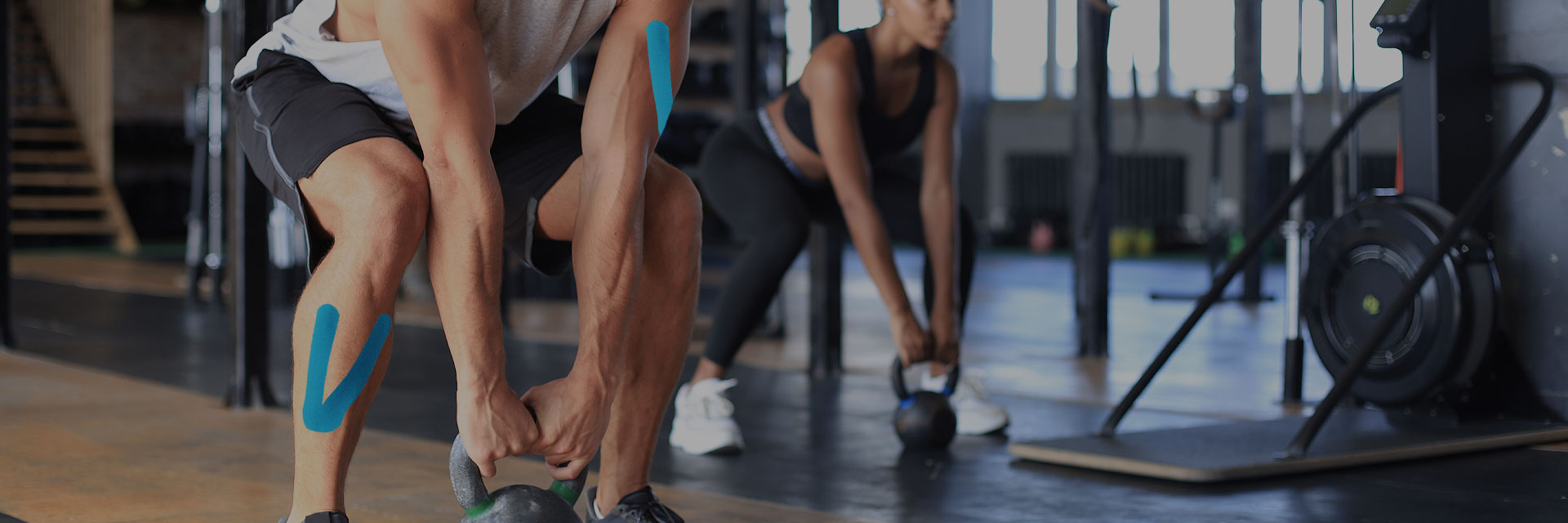
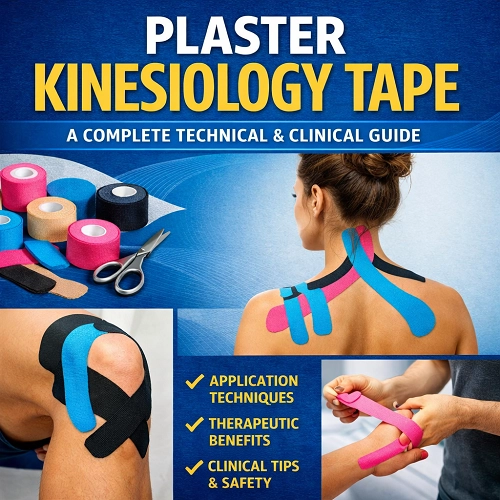
Plaster kinesiology tape — commonly called KT tape, kinesio tape, or muscle tape — is a highly elastic, adhesive therapeutic tape applied directly to the skin over muscles, joints, and connective tissue. Unlike traditional rigid sports strapping tapes designed to immobilize a joint, kinesiology tape is engineered to closely mimic the thickness, weight, and elasticity of human skin, allowing the underlying tissue to move freely while still receiving mechanical and neurological support.
The "plaster" designation refers to the tape's pressure-sensitive adhesive backing — a hydrophobic or acrylic-based coating applied to one side of the elastic fabric substrate. This adhesive layer is what gives the tape its distinctive wave-pattern texture, facilitates microcirculatory effects on the skin surface, and provides durable wear of three to five days even during bathing, swimming, and vigorous exercise.
History & Origin
The development of kinesiology taping as a distinct therapeutic modality is widely attributed to Japanese chiropractor Dr. Kenzo Kase, who in the 1970s sought a supportive tape that would not restrict the range of motion during rehabilitation. Conventional zinc-oxide athletic tapes of the era were rigid and occlusive, limiting blood flow and requiring removal within hours. Dr. Kase's insight was to base the tape's elasticity on the approximate extensibility of human skin — roughly 130–140% of its resting length — so that the tape could move with the body rather than against it.
The technique migrated to Europe and the United States through rehabilitation practitioners during the 1980s and 1990s, but global public awareness accelerated dramatically at the 2008 Beijing Olympic Games, where brightly colored tape on the bodies of elite athletes attracted massive television coverage. As Jiaxing Fuluo notes, it was precisely this moment that introduced Chinese consumers and manufacturers to the technology on a mass scale, triggering rapid expansion from sports medicine into clinical rehabilitation, post-surgical care, and general musculoskeletal therapy.
Today, kinesiology tape is produced by hundreds of manufacturers across Asia, Europe, and the Americas, with global market demand driven by professional sports, physical therapy clinics, orthopedic departments, personal fitness enthusiasts, and post-operative rehabilitation programs. China has become the world's largest manufacturing hub for the product, with specialized clusters in Zhejiang Province, where Jiaxing Fuluo Medical Supplies Co., Ltd. operates its production facilities.
Materials & Construction
Fabric Substrate Options
The mechanical performance of a kinesiology tape is largely determined by the weave structure and fiber composition of its fabric substrate. The tape must stretch readily along its length (warp direction) while remaining relatively inextensible across its width (weft direction), producing the anisotropic elasticity that enables targeted mechanical input to underlying tissue.
| Fiber Type | Elongation | Breathability | Moisture Wicking | Typical Use |
|---|---|---|---|---|
| 100% Cotton | 140–160% | Excellent | Good | Standard clinical & athletic |
| Nylon | 150–180% | Very Good | Excellent | High-performance sports, waterproof |
| Rayon (Viscose) | 140–165% | Good | Moderate | Sensitive skin, clinical rehab |
| Cotton–Nylon Blend | 145–170% | Very Good | Good | Versatile OEM & branded tape |
Jiaxing Fuluo manufactures across this full spectrum, offering nylon kinesiology tape, rayon kinesiology tape, standard cotton-based tape, and blended variants through its OEM customization program. Crucially, the company operates its own fabric factory, which ensures consistency of raw material quality that external sourcing cannot guarantee.
Weave Structure & Elongation Engineering
The signature elasticity of kinesiology tape derives from spandex or elastane yarns integrated into the warp threads of the woven or knitted substrate. The ratio of elastane to primary fiber, combined with the tension at which the fabric is woven, determines both the resting stiffness and the maximum elongation before the tape reaches its elastic limit. Premium tapes are engineered with a progressive force-elongation curve — gentle initial resistance increasing smoothly — to match the non-linear mechanical behavior of biological soft tissue.
The backing surface of the fabric substrate is laser-cut or embossed with a distinctive wave or chevron pattern that serves two functions: it provides a tactile reference for consistent tensioning during application, and it creates a micro-textured skin interface that distributes shear stress more uniformly across the contact area, reducing the risk of adhesive-related skin irritation.
Adhesive Technology
Acrylic Pressure-Sensitive Adhesive (PSA)
The adhesive system is the single most critical performance variable in a kinesiology tape product. The dominant technology is the water-based acrylic pressure-sensitive adhesive (PSA), which is applied as an aqueous dispersion to the fabric backing and then thermally cured to form a cohesive, viscoelastic film. Acrylic PSAs deliver superior performance across several dimensions: low sensitization rates, resistance to hydrolysis (enabling waterproof wear), excellent UV stability, and minimal residue on removal.
The wave or fingerprint pattern in which the adhesive is applied — rather than as a continuous film — is not merely aesthetic. The interrupted geometry reduces the total contact area between adhesive and skin by approximately 30–40%, dramatically lowering cumulative shear stress and reducing perspiration entrapment beneath the tape. The channels between adhesive peaks serve as microventilation pathways, enabling the tape to function as a breathable membrane even in high-humidity exercise environments.
Jiaxing Fuluo sources its pressure-sensitive acrylic adhesive from Japanese suppliers, a deliberate technical decision that maintains the low sensitization profile expected by European and North American health product markets. Japanese acrylic PSA formulations are formulated to minimize residual monomer content — the primary allergen source in lower-grade adhesives — and are subjected to accelerated aging tests to confirm peel adhesion stability over multi-day wear periods.
Hot-Melt Adhesive Variants
An alternative adhesive system uses thermoplastic hot-melt compounds — typically styrene-block copolymers with added tackifiers and plasticizers. Hot-melt adhesives offer higher initial tack and are preferred in certain semi-finished product applications where the tape serves as a laminate component in wound dressings or surgical drapes. However, hot-melt systems tend to exhibit greater sensitivity to elevated skin temperatures, slightly reduced long-term peel strength in aqueous environments, and a higher incidence of skin irritation in sensitive populations compared to water-based acrylics. Fuluo maintains dedicated production lines for both systems to serve differentiated application needs.
Peel Adhesion Testing & Standards
Adhesive performance is quantified by peel adhesion tests conducted at standardized angles (typically 180°) and speeds. ISO 29862 (Methods of test for self-adhesive tapes) and ASTM D3330 provide the relevant reference frameworks. A premium kinesiology tape typically targets a peel adhesion of 0.5–1.5 N/25mm on standard stainless steel panels, calibrated to provide adequate skin adherence without generating skin stripping forces on removal. Shear resistance is tested per ISO 29863, and moisture vapor transmission rate (MVTR) is assessed per ASTM E96 to confirm breathability performance.
Therapeutic Mechanisms
The clinical rationale for kinesiology taping rests on several interrelated physiological mechanisms. While the precise weighting of each mechanism remains an active area of research, there is substantial evidence — and broad practitioner consensus — supporting the following pathways:
Skin Lift Effect & Microcirculatory Enhancement
When applied with tension to skin stretched over an underlying muscle, kinesiology tape creates microscopic convolutions — rugae — in the skin surface as the tape recoils toward its resting length. These micro-folds are hypothesized to create a pressure gradient that decompresses the superficial tissue layers between skin and fascia, reducing local mechanical pressure on pain receptors (nociceptors) and creating space for improved lymphatic drainage and microvascular circulation.
Increased local blood flow accelerates the removal of metabolic waste products (lactate, prostaglandins, bradykinin) that accumulate in overworked or injured tissue, reducing both immediate pain and the inflammatory cascade that follows tissue trauma. As documented in Fuluo's product specifications, this mechanism supports the tape's role in reducing congestion while allowing efficient circulation of oxygenated blood and lymphatic fluids.
Neurological & Pain Gate Modulation
The continuous mechanical stimulus provided by tape on skin activates cutaneous mechanoreceptors — particularly Meissner's corpuscles and Ruffini endings — generating proprioceptive afferent signals transmitted via large-diameter Aβ fibers. According to the gate control theory of pain (Melzack & Wall, 1965), this non-nociceptive input competes at the dorsal horn of the spinal cord with pain signals transmitted via smaller-diameter Aδ and C fibers, effectively reducing perceived pain intensity without pharmacological intervention.
Muscle Facilitation & Inhibition
The direction, tension, and anchor point of tape application can be varied to produce either a facilitatory or inhibitory effect on the underlying muscle. Tape applied from muscle origin to insertion (with the muscle at or near full stretch) generates a force along the muscle's line of action and is thought to enhance motor recruitment — clinically useful for hypotonic muscles, post-surgical atrophy, or neurological weakness. Conversely, tape applied from insertion to origin (inhibitory technique) with the muscle in a shortened position may reduce hypertonicity and spasm in overactive muscles.
Postural Correction & Proprioceptive Cueing
Applied across postural muscles of the cervical or lumbar spine, kinesiology tape provides continuous tactile feedback to the wearer about spinal position. When the spine deviates from optimal alignment, the tape generates a slight skin pull that cues corrective muscular activation. This somatosensory feedback mechanism is distinct from the passive mechanical correction provided by orthoses and braces — rather than forcing a position, it trains the nervous system toward self-correction.
Clinical & Sports Applications
Kinesiology tape is applied across a remarkably wide spectrum of conditions. Fuluo's applications section groups these into four primary domains:
Sports Medicine & Athletic Performance
In sports applications, kinesiology tape is used both prophylactically (before activity to reduce injury risk) and therapeutically (after injury to facilitate return to play). Common sports applications include patellar tracking dysfunction and patellofemoral pain syndrome (knee), rotator cuff support and acromioclavicular joint protection (shoulder), ankle inversion sprain management and Achilles tendinopathy loading modulation (foot/ankle), hamstring and quadriceps strain rehabilitation, tennis elbow (lateral epicondylitis) and golfer's elbow (medial epicondylitis) management, and shin splint (medial tibial stress syndrome) pain modulation.
Post-Surgical & Clinical Rehabilitation
In surgical and clinical contexts, tape is applied in post-mastectomy lymphedema management (using the fan-cut technique to stimulate lymphatic flow), post-total knee or hip arthroplasty swelling reduction, scar management (cross-tape technique to modulate fascial adhesion), and neurological rehabilitation for conditions including hemiplegia and cerebral palsy to facilitate weak muscle activation.
Medical & General Healthcare
The medical application domain extends to chronic pain management (cervical spondylosis, lumbar disc herniation), pregnancy-related low back and pelvic girdle pain, pediatric postural correction, fasciitis conditions including plantar fasciitis and iliotibial band syndrome, and joint effusion and synovitis management.
Personal Care & Aesthetics
The personal care segment includes boob tape (breast support and lift for fashion and comfort), posture correction tape for desk workers and gamers, and cosmetic lymphatic drainage taping. Fuluo manufactures dedicated boob tape formulated with skin-tone adhesive and hypoallergenic acrylic for prolonged skin contact in sensitive areas.
Application Techniques & Cutting Methods
Tension Guidelines
The amount of stretch applied to the tape during application is a critical technical variable that determines both the mechanical and neurological effects achieved:
| Tension Level | % Elongation Applied | Primary Effect | Typical Application |
|---|---|---|---|
| Paper-off tension | 0–10% | Lymphatic / circulatory | Edema, post-surgical swelling |
| Light tension | 15–25% | Muscle inhibition, pain relief | Muscle spasm, hypersensitive tissue |
| Moderate tension | 25–50% | Facilitation, postural cue | Weak muscle activation, postural correction |
| Full tension | 50–75% | Mechanical joint support | Instability, acute ligament sprain |
| Maximum tension | 75–100% | Rigid-like structural support | Acute joint protection, used sparingly |
Quality Standards & Certifications
The classification of kinesiology tape under national and international regulatory frameworks varies by jurisdiction and intended use. Tape marketed for therapeutic use in wound management or post-surgical application is typically regulated as a Class I or Class II medical device, requiring demonstration of biocompatibility under ISO 10993 and manufacturing under a certified Quality Management System.
Jiaxing Fuluo's quality and certification infrastructure is among the most comprehensive in the industry for a Chinese kinesiology tape manufacturer:
ISO 13485:2016
Medical devices quality management system certification. Governs all processes from raw material procurement through finished product release and post-market surveillance.
CE Mark
Conformity with European Union Medical Device Regulation (EU MDR), enabling direct supply to European healthcare distributors, hospitals, and pharmacies.
FDA Registration
U.S. Food & Drug Administration facility registration and product listing, required for import and commercial distribution in the United States market.
In-House Laboratory
Two dedicated laboratories with instruments for microbial detection, environmental monitoring, peel adhesion testing, and chemical analysis of adhesive formulations.
Buyers sourcing kinesiology tape for medical device distribution channels must verify that supplier documentation includes a valid ISO 13485 certificate with current scope statement, CE technical file reference, and Declaration of Conformity. CE certification obtained before May 2021 under the older Medical Device Directive (MDD 93/42/EEC) may require re-assessment under the current EU MDR 2017/745 framework. Fuluo maintains current certifications under the updated regulatory frameworks.
Jiaxing Fuluo: Industry Pioneer & Manufacturing Capability
About Jiaxing Fuluo Medical Supplies Co., Ltd
Jiaxing Fuluo Medical Supplies Co., Ltd is recognized as one of China's earliest dedicated kinesiology tape manufacturers, tracing its origins to 2007 in Suzhou before establishing its current purpose-built facility at No. 1989 Gaoqiao Avenue, Gaoqiao Town, Tongxiang, Jiaxing City, Zhejiang Province. The company earned its current medical device manufacturer status with the establishment of Jiaxing Fuluo Medical Supplies Co., Ltd in 2015.
Fuluo's competitive distinction lies in vertical integration: the company operates its own fabric mill alongside its tape manufacturing facility, providing direct quality control over the single most variable input — the elastic substrate — that most competitors source from third parties. This enables Fuluo to guarantee the fabric quality stability that is foundational to adhesive coating consistency and finished tape performance.
With over 30% market share in the Japanese kinesiology tape market and export presence in Southeast Asia, North America, and Western Europe, Fuluo is a primary supply partner for numerous international brand owners operating OEM agreements. Explore the full product catalog or inquire about customization options.
Production Infrastructure
The Fuluo manufacturing complex encompasses a 12,000 m² production floor, 2,700 m² office building, and 500 m² GMP 100,000-class cleanroom workshop. Three dedicated production lines cover athletic sports tape, medical tape, and wound dressing products. Each production stage — from acrylic glue coating and thermal curing through slitting, re-cutting, and automated packaging — is managed within its own independent workshop, with in-process sampling conducted by dedicated quality control personnel.
The quality control department employs over ten full-time inspectors and operates equipment including delamination rate testing machines, gas chromatographs for adhesive residual monomer analysis, blast dryers, and automated coating machinery. Pre-production sampling and pre-shipment final inspection are standard protocol for all orders, including custom OEM programs.
How to Select the Right Kinesiology Tape
Selecting the optimal tape for a given application requires systematic evaluation of several technical and clinical parameters:
| Selection Criterion | Key Questions | Recommended Tape Type |
|---|---|---|
| Activity environment | Water sports, heavy perspiration, long wear duration? | Waterproof nylon tape |
| Skin sensitivity | History of tape allergy, sensitive or fragile skin? | Rayon substrate, Japanese acrylic PSA, paper-off tension only |
| Clinical objective | Lymphatic drainage vs. structural joint support? | Fan cut (lymphatic) vs. I-strip high tension (structural) |
| Application site | Highly contoured anatomy (shoulder, foot arch)? | Narrow width (2.5–3 cm), pre-cut or Y-strip |
| User skill level | Self-application by patient vs. clinician-applied? | Pre-cut kinesiology tape for patient self-use |
| Commercial channel | OEM branding, private label, or custom print? | Customization program |
Frequently Asked Questions
How long can kinesiology tape be worn?
Quality kinesiology tape is designed for continuous wear of three to five days under normal activity conditions, including showering and swimming (for waterproof variants). Tape should be removed if significant itching, redness, blistering, or skin maceration develops. Removal is best performed slowly by folding the tape back over itself at a low angle while supporting the adjacent skin.
Is kinesiology tape safe for all skin types?
The vast majority of users tolerate kinesiology tape without adverse reaction, particularly products using water-based acrylic PSA with low residual monomer content. Individuals with a known sensitivity to acrylate adhesives, or with compromised skin integrity (open wounds, active dermatitis, radiation-damaged skin), should consult a healthcare professional before use. Performing a 24-hour patch test on the inner forearm is recommended for first-time users.
What distinguishes medical-grade from consumer-grade kinesiology tape?
Medical-grade tape is manufactured under ISO 13485 quality management systems, uses adhesives tested for biocompatibility per ISO 10993, carries CE and/or FDA registration documentation, and is subject to formal batch release testing including microbiological and chemical analysis. Consumer-grade tape may lack some or all of this documentation and may use lower-specification adhesive systems. For therapeutic use in clinical or post-surgical contexts, medical-grade certification is the appropriate specification.
Can I order custom-branded kinesiology tape?
Yes. Jiaxing Fuluo's OEM customization program supports custom colors, custom printed designs, custom widths, custom roll lengths, and private-label packaging. The company accepts a range of payment currencies and international shipping terms including FOB, CIF, DDP, and others. Contact the Fuluo team at fuluo@jxfuluo.com or via the online inquiry form.
What is the difference between kinesiology tape and medical plaster tape?
Kinesiology tape is highly elastic (140–180% elongation) and primarily used for muscle support, pain modulation, and functional movement enhancement. Medical plaster tape is generally less elastic or non-elastic, and is designed for tube fixation, IV catheter securing, wound dressing retention, and surgical draping — applications demanding high adhesive strength and positional stability rather than dynamic movement accommodation.


