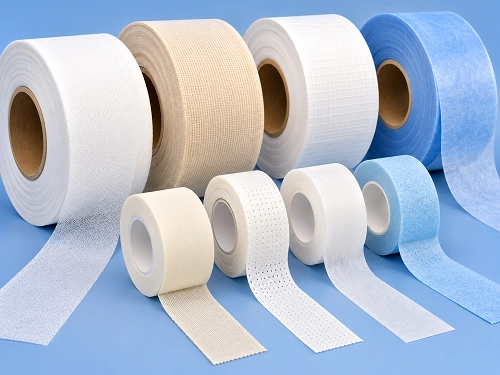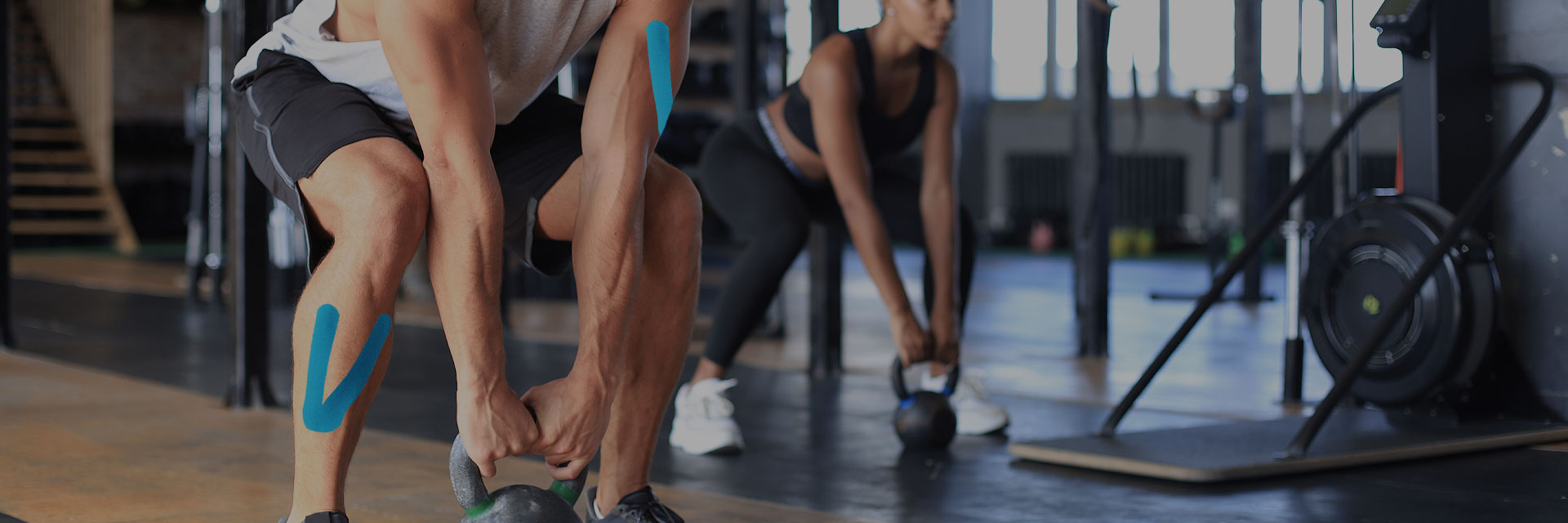
Medical tape raw material rolls — often called jumbo rolls or mother rolls in the converting industry — are the semi-finished adhesive substrates that get slit, cut, and packaged into the finished tapes, plasters, and dressings used across hospitals, clinics, sports medicine, and home first-aid. For OEM brands, distributors, and private-label buyers, understanding how these rolls are engineered is essential to sourcing the right product for the right clinical or athletic application.
What Are Medical Tape Raw Material Rolls?
A medical tape raw material roll is an unconverted, wide-format roll of adhesive-coated backing material, typically supplied in "jumbo" widths of one to two meters before it is slit down into narrower finished-product widths. These rolls form the upstream supply for kinesiology tape, rigid sports strapping, wound closure tape, IV fixation dressings, and electrode padding. Rather than manufacturing every finished SKU from scratch, many medical device brands, hospital suppliers, and sports tape resellers purchase medical roll materials in bulk and finish the product locally — cutting, printing, packaging — under their own branding.
Core Categories of Medical Tape Raw Material Rolls
Raw material rolls are generally classified by backing substrate and adhesive system. The table below summarizes the most common categories sourced by converters and OEM buyers.
| Roll Type | Backing Material | Typical Adhesive | Primary Use |
|---|---|---|---|
| Kinesiology Tape Jumbo Rolls | Cotton or rayon knit fabric | Acrylic, heat-activated | Muscle/joint support, rehabilitation |
| Rigid Sports Tape Jumbo Rolls | Cotton/zinc oxide-coated cloth | Zinc oxide adhesive | Joint immobilization, injury prevention |
| Elastic Adhesive Fabric Rolls | Woven or elastic cloth | Rubber-based or acrylic | Compression bandaging, fixation |
| PU Film Adhesive Rolls | Polyurethane film | Acrylic (breathable) | Transparent dressings, IV/cannula fixation |
| PE Foam Electrode Rolls | Polyethylene foam | Conductive/medical-grade adhesive | ECG/TENS electrode pads, padding |
| Non-woven Adhesive Rolls | Non-woven spunlace/spunbond | Hypoallergenic acrylic | Wound dressings, surgical tape, plasters |
Manufacturing Process: From Substrate to Finished Roll
Producing a consistent, medical-grade jumbo roll requires tight control across several converting stages. A typical production line follows this sequence:
- Substrate preparation — cotton, rayon, non-woven, or polyurethane film is unwound and inspected for defects before coating.
- Adhesive coating — a hot-melt, solvent-based, or acrylic emulsion adhesive is applied via knife-over-roll, gravure, or slot-die coating heads at a controlled gsm (grams per square meter) coat weight.
- Drying/curing — the coated web passes through temperature-controlled ovens to remove solvent or activate cross-linking, which determines final tack and shear strength.
- Laminating — a release liner (siliconized paper or film) is laminated onto the adhesive face to protect it prior to slitting or die-cutting.
- Slitting and rewinding — the master jumbo roll is slit into narrower widths and rewound onto cores under precise tension control to avoid telescoping or wrinkling.
- Inspection and packaging — rolls undergo visual and dimensional inspection, then are vacuum- or shrink-wrapped for shipment.
Companies offering full-chain manufacturing capability — coating, laminating, slitting, and die-cutting under one roof — tend to deliver more consistent adhesive performance because coat weight, tension, and curing parameters stay within a single controlled system rather than being handed off between separate subcontractors.
Key Technical Specifications to Evaluate
When sourcing raw material rolls, buyers should request a full technical data sheet. The parameters below are the ones that most directly affect finished-product performance.
| Specification | Why It Matters |
|---|---|
| Total thickness (mm) | Affects conformability, bulk, and comfort during wear |
| Adhesive coat weight (gsm) | Determines initial tack, adhesion-to-skin strength, and wear time |
| Tensile strength (N/cm) | Indicates resistance to tearing during application or removal |
| Elongation (%) | Critical for kinesiology and elastic tapes that must move with the body |
| Moisture vapor transmission rate (MVTR) | Determines breathability and skin maceration risk under occlusive dressings |
| Peel adhesion (N/25mm) | Balances secure fixation against gentle, low-trauma removal |
| Roll width and length tolerance | Affects downstream slitting yield and converting waste |
Quality Control and Certification
Because these materials contact skin — sometimes broken skin — quality assurance is non-negotiable. Reputable converters maintain dedicated QC stations covering microbiological testing, environmental monitoring, and physical/chemical performance testing, and typically operate under ISO 13485 quality management for medical devices alongside biocompatibility testing (ISO 10993) for skin contact materials. Buyers should always request current system certification documents and batch-level test reports before placing bulk orders.
Common Applications
| Application Area | Typical Raw Material Used |
|---|---|
| Sports & rehabilitation | Kinesiology and rigid strapping rolls |
| Surgical & clinical care | Non-woven and PU film rolls |
| Personal & home care | Non-woven adhesive and plaster rolls |
| General medical fixation | PU film, elastic fabric rolls |
Why Manufacturer Scale and Experience Matter
Consistency across large production runs depends heavily on a manufacturer's coating capacity, workforce experience, and years in the field. FULUO Medical, based in Zhejiang, China, has operated since 2007 and has grown into a full-chain producer of medical adhesive materials, with a factory footprint of roughly 20,000 square meters and an annual coating capacity of about 4 million square meters. The company also reports an approximate 30% market share in Japan's sports and medical tape sector, reflecting sustained export experience with demanding overseas buyers. For OEM and private-label partners, this kind of scale typically translates into shorter lead times, broader roll-width options, and more flexible customization for adhesive formulation, backing color, and packaging.
Sourcing Checklist for Buyers
- Confirm backing substrate composition and country of origin for raw fibers/films.
- Request adhesive type disclosure (acrylic, rubber-based, hot-melt) and any known allergen data.
- Ask for peel adhesion, tensile strength, and MVTR test reports for the specific batch.
- Verify ISO 13485 and biocompatibility certification validity dates.
- Clarify minimum order quantity, standard jumbo roll widths, and custom slitting options.
- Review the supplier's technical blog and industry updates to gauge ongoing product development and material innovation.
Medical tape raw material rolls sit at the foundation of the entire adhesive medical products supply chain. Getting the backing material, adhesive chemistry, and converting process right at the roll stage determines how well the finished tape or dressing performs in the field — whether that's a physiotherapist applying kinesiology tape or a nurse securing an IV line. Buyers who understand these technical fundamentals are better equipped to evaluate suppliers, negotiate specifications, and avoid costly quality issues downstream. For further technical reading and current industry updates on adhesive coating and converting, see the Medical Converting Explained article and the broader FULUO Medical blog.