86-0573-88960598 / Sales & Service Support
Email:fuluo@jxfuluo.com
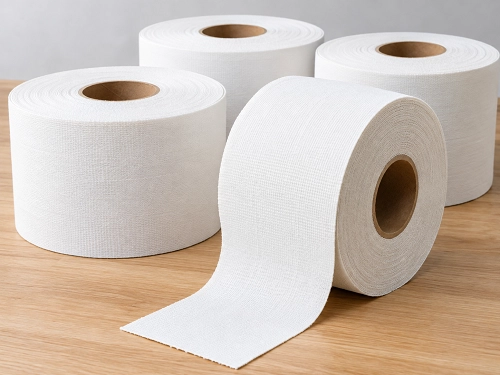
Rigid sports tape looks simple: a fabric, an adhesive and a roll. But the jumbo roll is where most quality problems begin. A weak tear line, uneven adhesive coating or a badly wound roll will show up later as rejected batches, customer complaints or lost converting yield.
A jumbo roll is the wide, long, coated raw material from which finished tapes are slit and rewound. For rigid tape, the base is a non-stretch fabric, usually cotton or rayon, coated with a pressure-sensitive adhesive on one side. The finished tape is used to limit joint motion, hold a position and keep a bandage or pad in place. Unlike elastic products, rigid tape is meant to resist stretch.
According to the FULUO product page, these rolls are offered with Hot Melt or Zinc Oxide adhesive systems, on a 3-inch paper core, with a PET release film. Customers can customize roll width and length, color, fabric weight, adhesive coating weight and punching. The same material can be converted into sports tape, rehabilitation support, dressing fixation tape, veterinary wraps and general-purpose fixation tape.
The table below lists the options published on the product page. The last column adds practical notes from converting experience. Confirm exact values for your project with the sales team.
| Item | Available Option | What It Means in Practice |
|---|---|---|
| Carrier | Cotton, rayon, PFAS-free adhesive option | Cotton feels traditional and tears cleanly. Rayon is typically smoother and softer. Ask for a PFAS declaration if you sell into regulated markets. |
| Adhesive type | Hot melt or zinc oxide | Drives tack, skin feel, coating process and allergen profile (see the next section). |
| Adhesion level | Aggressive | Strong holding suits athletic use, but it raises skin-removal considerations. Underwrap is often recommended. |
| Core | 3-inch paper core | Compatible with common industrial slitter-rewinder shafts. |
| Release | PET release film | A stable, smooth liner helps clean unwinding and consistent die-cut edges. |
| Customization | Roll width and length, color, fabric weight, coating weight, punching | Tune the tape for tear feel, holding power and cost per finished roll. |
Neither system is better in every case. Zinc oxide adhesive is the classic choice for athletic tape, with a long history in the category. Hot melt adhesive is applied without solvents and gives more control over coating uniformity. FULUO covers zinc oxide tape in more depth in its article on zinc oxide sports tape for injury prevention and rehabilitation.
| Factor | Hot Melt Adhesive | Zinc Oxide Adhesive |
|---|---|---|
| Positioning | Modern, process-controlled, consistent | Traditional athletic-tape feel |
| Coating consistency | Generally easier to hold tight coat-weight tolerance | Depends heavily on formulation and coating control |
| Typical buyer concern | Adhesive residue and heat performance | Rubber content and skin sensitivity declarations |
| Best fit | Private label programs needing repeatable batches | Brands whose customers expect a classic zinc oxide tape |
One point buyers often miss: rubber-based systems can raise latex-related labeling questions. Ask for the formulation declaration before you print packaging claims.
Product claims should be honest, and the research supports a careful message. A systematic review by Dizon and Reyes (2010) pooled seven moderate-quality trials. It found that among athletes with a previous ankle injury, taping was associated with a reduction in sprains of roughly 71%, and no single type of external support beat the others. An overview of 46 systematic reviews by Doherty and colleagues (2017) also found consistent evidence that external supports such as braces and tape lower the risk of ankle re-injury.
The mechanism is less clear. A review by Hume and Gerrard (1998) noted that tape provides only limited mechanical restraint at the ankle and may work partly through proprioception and by reminding the athlete to control joint loading. For manufacturers, the lesson is practical: sell rigid tape as a support and confidence aid for higher-risk activity and rehabilitation, and avoid promising that it "locks" a joint. Full sources are listed at the end of this article.
Hand-tear quality. Easy tearing depends on fabric construction, thread count balance and finishing. If the tear runs diagonally, users cannot apply the tape quickly. Test tear behavior by hand on samples from several positions across the web, not only from the roll edge.
Coating uniformity across the web. Adhesive weight that drifts from edge to center gives you narrow tapes with different holding strength depending on where they were slit. Ask for coat-weight data taken across the full width, not a single average.
Roll winding and edge condition. Telescoping, soft cores and edge bleed cause slitter stoppages. A jumbo roll that looks fine on delivery can still cause trouble if winding tension was inconsistent.
Storage and heat. Pressure-sensitive adhesives can creep or bleed in hot, humid warehouses. See FULUO's guide to summer precautions for medical adhesive materials for storage and transport practices. For the wider process picture, read Medical Converting Explained and the article on precision-engineered adhesive coating.
Agree on test methods with your supplier before the first order. ASTM D3330/D3330M is a widely used method for peel adhesion of pressure-sensitive tape, and ASTM D3759/D3759M covers tensile strength and elongation of pressure-sensitive tape. Your own quality agreement may specify different methods, so treat the table as a starting point.
| Property | Reference Method | Why It Matters |
|---|---|---|
| Peel adhesion | ASTM D3330/D3330M | Confirms holding power against the agreed spec. |
| Tensile strength and elongation | ASTM D3759/D3759M | Verifies that the tape stays rigid and does not stretch under load. |
| Coat weight uniformity | Supplier or in-house gravimetric method | Controls consistency between slit lanes and batches. |
| Hand tear and unwind | Sample panel test | Tests the features end users notice first. |
| Biocompatibility documentation | ISO 10993-1 framework | Needed if the finished tape is positioned as a medical product. |
Rigid tape is chosen when you want motion restriction and firm fixation. If your customers want stretch and skin-like movement, look at Kinesiology Tape Jumbo Rolls. For conforming wraps and compression, see Elastic Adhesive Fabric Rolls. Many brands carry both a rigid and a kinesiology line, which lets them share adhesive know-how, packaging and quality systems. You can compare finished products on the Sports Tape Products page or browse all Medical Roll Materials.
Jiaxing Fuuluo Medical Supplies Co., Ltd (FULUO Medical) is based in Zhejiang, China. The company website states that it was founded in 2007 and operates a 20,000 m² factory. It reports annual output of about $18 million, 160 employees and 4 million square meters of adhesive coating per year. It also reports a 30% share of the Japanese market and more than 10 full-time inspectors covering microbiological, environmental and physical-chemical testing. FULUO describes itself as one of the earlier kinesiology tape manufacturers in China and says it has developed more than 100 tape types for medical and sports customers.
For due diligence, review the quality control, manufacturing ability and system certification sections, and the company profile. If you need traceability for regulated markets, the article on UDI marking capability explains what FULUO supports. For background reading, try Medical Adhesive Jumbo Rolls: The Complete Technical & Sourcing Guide and the Sports Medical Tape technical guide.