86-0573-88960598 / Sales & Service Support
Email:fuluo@jxfuluo.com
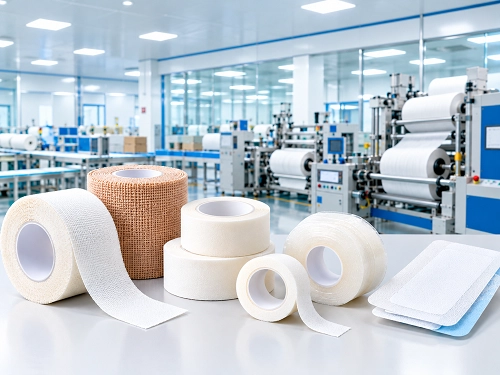
There is no list of “reliable Chinese manufacturers” that stays true for long, and any article offering one should make you suspicious. Reliability is a property of a specific factory, making a specific product, under a specific quality system, in a specific year. What you can do is verify it.
A tape that looks identical on a sample card can fail in very different ways once it is on skin or in a hospital supply chain. The failures that cost buyers money are rarely dramatic. They are quiet and statistical:
So a reliable supplier is one whose process makes these failures unlikely and whose records let you prove it. Everything below follows from that.
The reference standard is ISO 13485:2016, the quality management standard for medical devices. A logo on a website proves nothing. Request the certificate, then do two things: look the certificate number up through the accreditation-body-backed IAF CertSearch database, and read the scope line. A certificate covering “assembly of medical devices” does not necessarily cover adhesive coating or slitting. The scope should describe what you are buying.
A factory that tests only at final inspection finds problems after the material is already coated, slit and packed. Ask which of these are run on every lot, and whether they follow a named method:
Floor area impresses but says little. What matters is whether the steps that expose adhesive and product contact surfaces run in a controlled space. Older “Class 100,000” wording corresponds roughly to ISO Class 8 under ISO 14644-1. That is a reasonable level for tape and dressing converting, but ask which process steps sit inside it and whether particle counts and microbial monitoring are recorded.
Pressure-sensitive medical tape follows a fixed route: coat the adhesive, dry it, laminate it to the backing and release liner, let it stabilise, then slit, rewind, die-cut and pack. Each stage is a place where variation enters. Suppliers who control coating and converting under one roof can trace a complaint back to a coating run; suppliers who outsource the coating can only trace back to a purchase order. Ask whether lots are traceable from jumbo roll to carton, and whether unique device identification (UDI) marking is supported if your market needs it.
A factory that is too small will miss deadlines; one that is far too large may treat your order as filler. The useful number is coated area per year, because it converts into the length of tape you can actually buy. We do the arithmetic for one supplier in the table below.
Ask for a certificate number, a test method, and a reference customer in your market. A reliable supplier answers precisely or says “we will find out” and does. Evasive, rounded or inconsistent answers are themselves data.
According to its homepage, FULUO Medical (Jiaxing Fuuluo Medical Supplies Co., Ltd) was founded in 2007 in Zhejiang and describes itself as one of the earliest kinesiology tape manufacturers in China. It covers the chain from adhesive coating and slitting to finished product packing, supplying both medical roll materials and OEM finished goods. The table puts its published figures through the checks above. All figures come from the company's own pages (accessed October 13, 2026) and are self-reported; the right-hand column says what to confirm independently.
| Item | Published by FULUO | What it means for a buyer | Confirm before ordering |
|---|---|---|---|
| Operating history | Founded 2007 (19 years) | Long enough to have worked through multiple customer audits and market rule changes. | Years producing your product type specifically. |
| Coating capacity | 4 million m² of adhesive coating per year | About 11,000 m² a day over 365 days, or roughly 3,650 m² per line per day across three lines (our arithmetic, assuming even use). | Current utilisation and lead time at your order size. |
| Production lines | 3 lines (sports tape, medical tape, wound dressing); separate workshops for coating, stabilising, cutting and packing | Process separation reduces cross-contamination and makes stage-by-stage sampling practical. | A process flow chart with sampling points. |
| Clean workshop | 500 m² GMP 100,000-class workshop | Roughly ISO Class 8, suitable for tape and dressing converting. | Which steps run inside it; monitoring records. |
| Quality control | Two independent laboratories; 10+ full-time inspectors covering microbial, environmental and physical-chemical testing | In-house testing at several stages is a good sign. It also allows faster lot release than outsourcing. | The test list, methods and calibration records. |
| Workforce | 160 employees | A mid-sized plant: large enough for dedicated QC staff, small enough that senior people are reachable. | Who your technical contact will be. |
| Product development | 100+ tape types developed for medical and sports customers | Suggests flexibility on backing, adhesive and width for OEM projects. | Minimum order quantity for a custom spec. |
| Scale | US$18 million annual output | A specialist, not a commodity giant. | Whether your volume would be a meaningful share. |
| Market position | 30% market share in Japan | Japan is a demanding quality market, but the figure has no stated product category or year. | Treat it as a claim; ask which products and for a reference. |
| Factory area | Homepage: 20,000 m². “Why Choose Us” page: 10,000 m² land, 12,000 m² factory, 2,700 m² offices | The two pages do not agree. It may be a definitional difference (land versus built area), but it is exactly the kind of inconsistency a careful buyer should raise. | Ask for a site plan or audit report with the actual figure. |
Sources: FULUO homepage and Why Choose Us, accessed October 13, 2026. Daily-capacity figures are derived, not published by the company.
The strongest point is vertical integration. The Manufacturing Ability section describes independent workshops for glue coating, stabilisation, cutting and packing, with sampling by quality inspectors at each stage. That is the structure that lets a complaint be traced to a process step. The company also sells the intermediate product, with dedicated pages for kinesiology tape jumbo rolls, rigid sports tape jumbo rolls and PU film adhesive rolls, which is useful if you convert and pack under your own brand. Its blog also documents recent investments, including an expansion of custom kinesiology tape printing (August 2026) and a post on UDI marking capability (July 2026).
On the pages reviewed, the System Certification section shows images labelled as patent certificates. Patents show innovation; they are not a quality-system or product-safety approval. We did not find an ISO 13485 certificate number, a biocompatibility report or a market-specific registration listed in text, so ask for them directly. That is not a criticism unique to this supplier. Most manufacturers share such documents under NDA rather than publishing them. It simply means the website is the starting point, not the evidence.
A manufacturer can be excellent at one tape and average at another, so check depth in your category rather than breadth. FULUO's range is organised around three product families, each with its own page: sports tape (including uncut, waterproof and ventilated kinesiology tape), medical fixation tapes, and wound care dressings. If you need a private-label or modified specification, the OEM & customization page is the entry point.
One practical tip: if your product is skin-contact for long wear, such as a cannula fixation dressing or a multi-day sports tape, put adhesive coat weight and moisture-vapour permeability into the written specification. For a primer on how raw rolls differ before conversion, FULUO's medical tape raw material rolls guide and jumbo rolls guide are good background reading.
Whichever supplier you choose, a staged start reduces risk more than any amount of paperwork review:
Is “Made in China” a reliability risk in itself?
No. China hosts both audited, certified plants and unqualified workshops. The risk sits with the individual supplier, which is why verification beats geography.
Should I buy from a factory or a trading company?
A factory gives direct control over specification and traceability. A trading company can be convenient for small, mixed orders, but ask who actually coats the adhesive. For roll materials in particular, buying direct from the coater is usually preferable.
What is the single most revealing document to request?
A certificate of analysis for a recent production lot of your product, with test methods named. It shows what is actually measured and whether the numbers are plausible.