86-0573-88960598 / Sales & Service Support
Email:fuluo@jxfuluo.com
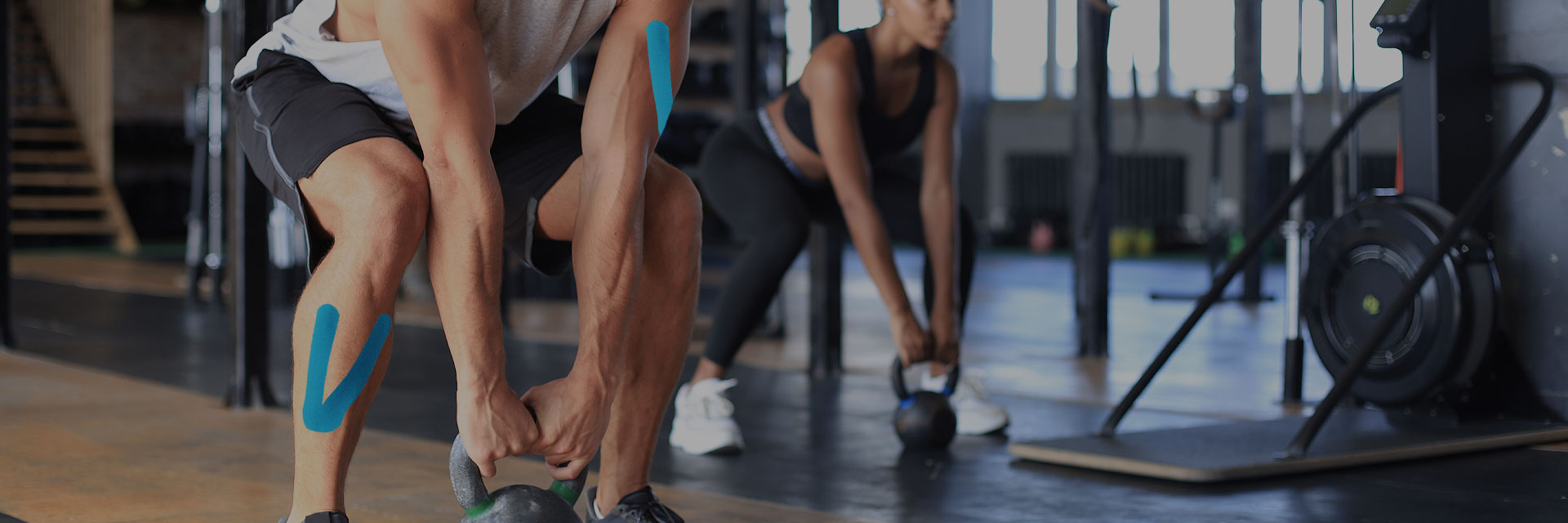
Kinesiology tape — widely known as KT tape or K-tape — has evolved from a niche rehabilitation tool into a mainstream staple for athletes, physiotherapists, and post-surgical care teams worldwide. Originally developed in Japan in the 1970s, the technology spread across Europe and the United States before reaching global prominence during the Beijing Olympic Games. Today, wholesale demand for kinesiology tape spans clinics, sports teams, personal care brands, and retail channels across every continent.
This guide covers the full technical landscape: material science, tape variants, clinical mechanisms, application protocols, and what to look for when sourcing from a manufacturing partner. References throughout point to the product range of Jiaxing Fuluo Medical Supplies Co., Ltd, a China-based factory operating since 2015 and supplying buyers across Southeast Asia, North America, and Western Europe.
Kinesiology tape is an ultra-thin, breathable, elastic adhesive tape designed to mimic the mechanical properties of human skin. Unlike rigid sports strapping tape, KT tape stretches longitudinally — typically 130–180 % of its resting length — allowing the treated area to retain a full, natural range of motion while still receiving mechanical support.
The tape is applied directly to the skin, over muscles, tendons, or joints. The wave-pattern acrylic adhesive on the underside creates a gentle lifting effect on the dermal layer, which is the central mechanism behind its therapeutic benefits. Because it is latex-free and uses acrylic pressure-sensitive glue (rather than zinc-oxide adhesives), skin irritation rates are significantly lower than with traditional rigid sports tape.
Four overlapping physiological mechanisms explain the therapeutic effect:
When applied with appropriate tension, the elastic recoil of the tape creates microfolds in the skin. These folds increase the interstitial space beneath the epidermis, reducing pressure on subcutaneous pain receptors (nociceptors) and improving lymphatic and blood flow through the decompressed channels.
The tactile stimulation of KT tape activates mechanoreceptors (Meissner's corpuscles and Merkel's discs) in the skin. This sensory input feeds into the gate-control pathway, modulating pain perception at the spinal cord level. Enhanced proprioceptive feedback from the tape also helps athletes maintain correct movement patterns, reducing re-injury risk.
Applied from origin to insertion (with no tension), KT tape facilitates a weakened or inhibited muscle. Applied from insertion to origin (with light stretch), it inhibits an overactive or spastic muscle. This bidirectional capability makes it useful across a wide diagnostic spectrum — from post-stroke hemiplegia to overuse tendinopathy.
Strategic multi-strip applications around unstable joints (e.g., the patella, the ankle, the AC joint) provide proprioceptive cueing and gentle mechanical guidance, helping to normalize joint alignment without blocking range of motion.
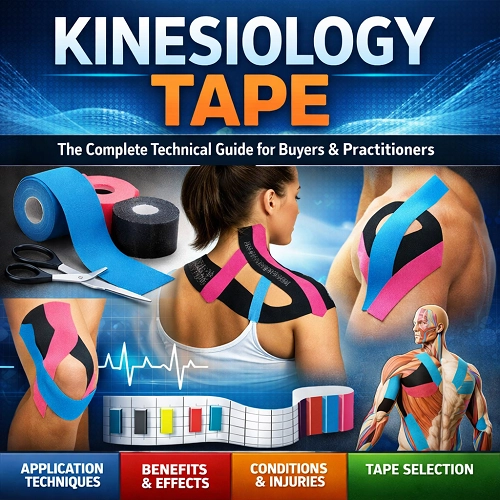
The Fuluo kinesiology tape range illustrates the breadth of variants available to wholesale buyers. The table below summarises the main product categories, their construction, and their primary use cases.
| Tape Type | Backing Material | Key Feature | Primary Application | Typical Width |
|---|---|---|---|---|
| Uncut Kinesiology Tape | 100% cotton or cotton-nylon blend | Continuous roll; cut to shape on-site | Clinical & sports general use | 5 cm × 5 m / 32 m |
| Waterproof Kinesiology Tape | Synthetic polymer (polyester/nylon) | Water-resistant adhesive; stays on during swimming | Aquatic sports, sweat-heavy activity | 5 cm × 5 m |
| Ventilate Kinesiology Tape | Open-weave cotton | High air permeability; minimises maceration | Long-wear clinical use, warm climates | 5 cm × 5 m |
| Pre-Cut Kinesiology Tape | Cotton or synthetic | Pre-shaped strips (I, Y, X, fan, donut) | Retail, consumer self-application | Various; packaged by body part |
| Nylon Kinesiology Tape | 100% nylon | Smooth texture; higher tear resistance | Sensitive skin; post-surgical use | 5 cm × 5 m |
| Rayon Kinesiology Tape | Rayon (viscose) | Soft drape; closest feel to cotton | Paediatric & elderly patients | 5 cm × 5 m |
| Elastic Adhesive Bandage | Woven cotton/polyester | Higher compression; adheres to itself | Strapping, joint compression | 2.5–7.5 cm × 4.5 m |
| Zinc Oxide Sports Tape | Cotton with zinc-oxide adhesive | Rigid, non-elastic; maximum joint immobilisation | Ankle & wrist strapping, contact sports | 2.5–5 cm × 10–13.7 m |
| Foam Underwrap Tape | Open-cell polyurethane foam | Protective layer under rigid tape | Skin protection beneath strapping | 7 cm × 27 m |
| Kinesiology Strip | Cotton or synthetic | Individual pre-cut application strips | Retail, single-use convenience | 25 mm × various |
| Custom Kinesiology Tape | Customer-specified | OEM/ODM; custom colour, logo, packaging | Brand retail, team/clinic branding | Custom |
| Boob Tape | Cotton or body-safe synthetic | Strong skin adhesion; fashion & strapless wear | Personal care / fashion | 5–7.5 cm rolls |
Cotton remains the most widely used backing because of its inherent breathability, moisture-wicking properties, and biocompatibility. Premium cotton tapes typically use a 97–98% cotton / 2–3% spandex or Lycra construction to achieve the target 130–160% elongation. Nylon backings offer superior tear resistance and a smoother surface finish, beneficial in post-surgical or sensitive-skin applications. Rayon mimics the soft drape of cotton with a slightly higher sheen and is preferred in paediatric applications.
The adhesive layer is equally critical. Fuluo specifies Japanese acrylic pressure-sensitive glue (PSA), which delivers:
Zinc-oxide adhesives, used in zinc oxide sports tape, offer stronger and more rigid bonding but carry a higher risk of skin irritation with prolonged wear. Waterproof grades swap the standard wave-pattern PSA for a full-coverage or modified-pattern coating that remains bonded in water.
| Property | Standard KT Tape | Waterproof KT Tape | Rigid Sports Tape |
|---|---|---|---|
| Elongation at break | 130–160% | 120–150% | <10% |
| Tensile strength (N/25mm) | 35–50 | 40–60 | 80–120 |
| Adhesion to skin (N/25mm) | 1.0–1.8 | 1.5–2.5 | 3.0–5.0 |
| Water resistance | Low–moderate | High | Low |
| Breathability (MVTR g/m²/24h) | 800–1200 | 400–700 | 200–400 |
| Typical wear duration | 3–5 days | 5–7 days | 1 day (game tape) |
The versatility of kinesiology tape is one of its defining commercial strengths. Fuluo maps its product range across four core application categories available on its Applications page:
| Application Segment | Typical Conditions Treated | Recommended Tape Type | More Info |
|---|---|---|---|
| Sports & Athletic | Muscle strains, plantar fasciitis, IT band syndrome, ankle sprains, patella tracking, tennis elbow, golfer's elbow | Uncut cotton KT tape, waterproof tape for water sports | Sports Applications |
| Post-surgical / Clinical | Oedema reduction, scar management, lymphoedema, post-mastectomy drainage | Ventilate tape, nylon tape (gentle adhesion) | Surgery Applications |
| Personal Care | Postural support, chronic back pain, desk-worker ergonomics, boob tape for fashion | Pre-cut strips, boob tape, foam underwrap | Personal Care Applications |
| Medical / Rehabilitation | Cervical spondylosis, lumbar disc herniation, stroke rehabilitation, scoliosis, arthritis | Rayon tape, custom kinesiology tape, elastic bandage | Medical Applications |
Correct taping technique is as important as tape quality. Practitioners typically use five standard cut patterns:
Pre-cut kinesiology tape products deliver these shapes out of the packet, reducing the clinical time and skill required for self-application — a major advantage in retail and consumer markets.
For distributors, physiotherapy chains, sports brands, and OEM importers, selecting the right manufacturing partner involves more than comparing price-per-roll. The table below outlines the key evaluation criteria.
| Criterion | What to Look For | Fuluo's Position |
|---|---|---|
| Fabric supply chain | Vertical integration reduces batch-to-batch variation | Owns its fabric factory for consistent raw-material quality |
| Adhesive specification | Medical-grade, low-sensitisation, acrylic PSA | Japanese acrylic PSA; latex-free |
| Quality control process | Pre-production sample + final shipment inspection | Pre-production sample before mass production; final inspection before shipment |
| Certifications | ISO 13485, CE, FDA registration where required | System certifications listed on Why Choose Us |
| Customisation capability | OEM/ODM: custom colour, logo, packaging, cut shape | Full customisation service |
| Production capacity | Sufficient daily output for large orders; scalability | High daily capacity confirmed; manufacturing details here |
| Incoterms & payment | Flexibility for international buyers | FOB, CIF, DDP, EXW and others; T/T, L/C, PayPal, credit card accepted |
The global kinesiology tape market has grown steadily since its Olympic exposure and is now served by a mix of established Western brands and high-volume Asian manufacturers. China-based factories dominate the wholesale supply chain, accounting for a large majority of global production capacity. Jiaxing Fuluo's export footprint reflects broader industry patterns: Southeast Asia represents the largest export share (approximately 40%), followed by domestic China (30%), North America (20%), and Western Europe (10%).
Key growth drivers include rising sports participation, ageing populations seeking non-pharmacological pain management, and expanding physiotherapy coverage in emerging markets. The fastest-growing sub-segments are waterproof tape (driven by aquatic sports and triathlon) and pre-cut consumer formats (driven by e-commerce and self-care trends).
Kinesiology tape rarely stands alone in a clinical or sports-therapy setting. Buyers typically source a range of complementary tape products from the same supplier for convenience and consistency. Fuluo's broader range includes:
Related product categories from Jiaxing Fuluo:
Medical Plaster Tape Wound Dressing Semi-finished Products Custom / OEM Tape Elastic Adhesive Bandage Foam Underwrap Zinc Oxide Sports Tape Elastic BandageJiaxing Fuluo Medical Supplies is a professional medical tape manufacturer headquartered in Zhejiang Province, China. Founded in 2015, the company employs 51–100 people and operates an integrated production model that covers fabric weaving, adhesive coating, slitting, and packaging — all under one quality-management system.
The company's stated mission, "technological innovation, product quality is the soul of the enterprise; market demand, customer satisfaction is the life of the enterprise," underpins a two-stage quality assurance process: pre-production samples for every new order, followed by final inspection before each shipment. More detail is available on the Quality Control and Manufacturing Ability pages.
For wholesale enquiries, buyers can reach the team at fuluo@jxfuluo.com or via the Contact Us page. The company accepts a broad range of international payment methods and shipping Incoterms, including FOB, CIF, DDP, and EXW.


